It's 4:30 PM on a sweltering 42°C Friday afternoon in Western Sydney. You commission a brand-new 7.1kW inverter split system, fire it up, and the moment the compressor kicks into high gear—click—the circuit breaker trips.
The homeowner is furious, the apprentice is scratching his head, and the sparky blames the fridgey. Almost always, the culprit comes down to two avoidable mistakes: an undersized breaker tripping on inrush current, or a missing outdoor rotary isolator that fails electrical sign-off under AS/NZS 3000:2018 Clause 4.19.
⚡ Quick Answer (Position 0 Cheat Sheet)
For standard Australian residential split systems, use a dedicated Type C MCB or RCBO: 16A on 2.5mm² for 2.5kW–3.5kW systems; 20A on 2.5mm² for 5.0kW–7.1kW systems; and 25A to 32A on 4.0mm² for 8.0kW–10.0kW systems. Under AS/NZS 3000 Clause 4.19, an outdoor lockable IP66 rotary isolator is legally mandatory within 3 metres and in direct line of sight of the outdoor condenser.
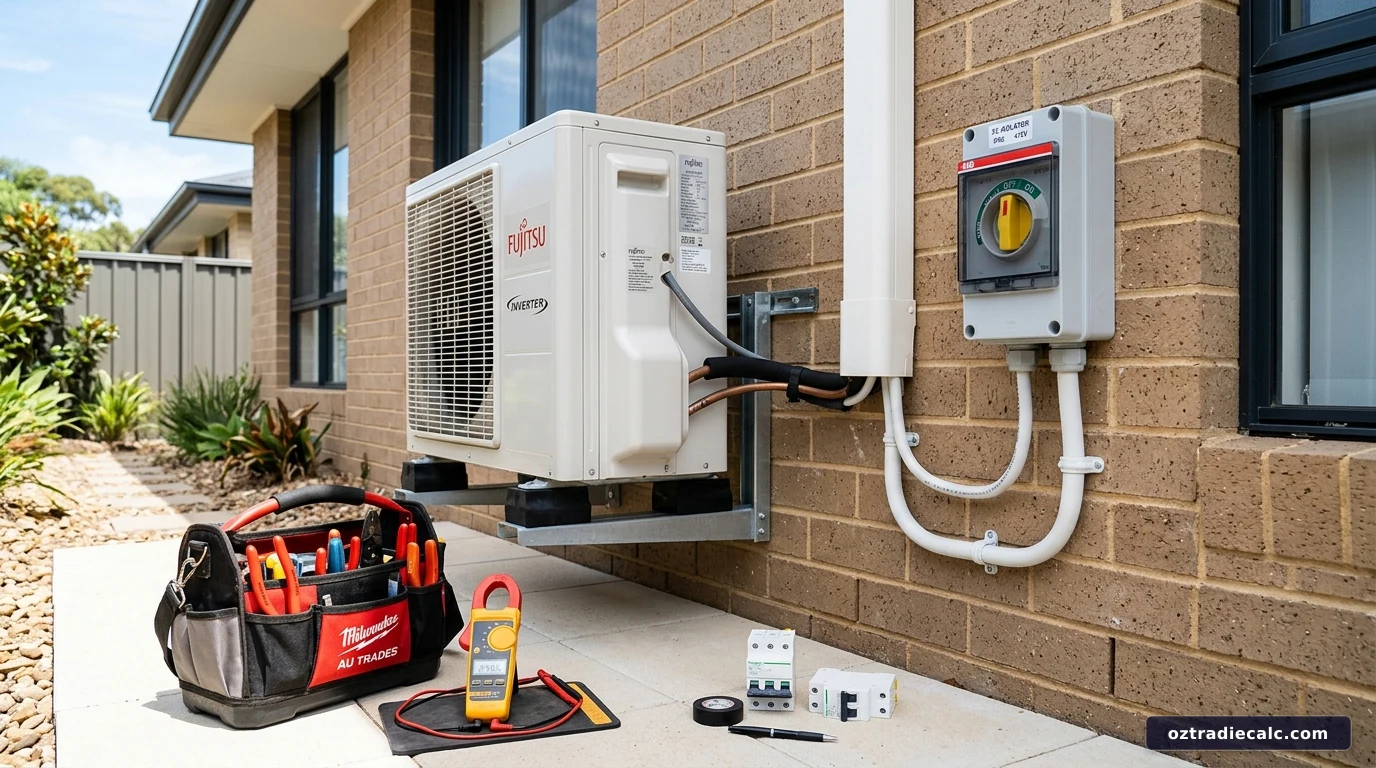
Split System Breaker & Cable Sizing Matrix (2.5kW to 10kW)
Never guess circuit sizes on site. The table below outlines standard single-phase 230V inverter split system ratings, full load amps (FLA), recommended Type C breakers, and minimum copper TPS cable sizes under AS/NZS 3008.1.1:
| Unit Capacity (Cooling/Heating) | Running Current (FLA @ 230V) | Max Recommended Breaker (Type C) | Minimum Cable Size (Copper TPS) | Typical Outdoor Isolator | Max Run Before 5% Volt Drop |
|---|---|---|---|---|---|
| 2.5 kW (Small Bedroom / Study) | 3.5A – 4.5A | 16A Type C (or 10A min) | 2.5 mm² Twin & Earth | 20A 2-Pole IP66 Rotary | ~ 38 metres |
| 3.5 kW (Master Bedroom / Small Lounge) | 5.0A – 6.5A | 16A Type C | 2.5 mm² Twin & Earth | 20A 2-Pole IP66 Rotary | ~ 32 metres |
| 5.0 kW (Medium Living Room) | 7.5A – 9.5A | 20A Type C | 2.5 mm² Twin & Earth | 20A 2-Pole IP66 Rotary | ~ 28 metres |
| 7.1 kW – 8.0 kW (Large Open-Plan Area) | 10.5A – 14.5A | 20A Type C (25A for older units) | 2.5 mm² – 4.0 mm² | 20A / 32A 2-Pole IP66 | ~ 22m (2.5mm²) / 36m (4mm²) |
| 9.0 kW – 10.0 kW (Entire Floor / Heavy Ducted) | 15.0A – 19.5A | 25A or 32A Type C | 4.0 mm² – 6.0 mm² | 32A 2-Pole IP66 Rotary | ~ 30 metres (6mm²) |
Note: Always verify the exact Minimum Circuit Ampacity (MCA) and Maximum Overcurrent Protection (MOCP) printed on the manufacturer nameplate sticker on the outdoor unit.
Why Type C Breakers Are Mandatory (Motor Inrush Current)
Why can't you just slap a standard domestic Type B circuit breaker on a split system?
When an air conditioning compressor starts, it experiences a momentary current spike called inrush current (or Locked Rotor Amps - LRA). Even modern DC inverter units experience a sudden current surge when ramping up the compressor and condenser fan simultaneously:
- Type B MCBs: Trip instantaneously at 3 to 5 times rated current. An 8A inverter compressor spiking to 28A on startup will trip a 16A Type B breaker every single time.
- Type C MCBs (Recommended): Trip instantaneously at 5 to 10 times rated current. They comfortably absorb the motor start surge for several cycles without nuisance tripping.
- Type D MCBs: Trip at 10 to 20 times rated current. Only required for heavy commercial three-phase industrial scroll chillers, rarely needed in residential homes.
To check specific trip curves and time-current boundaries for your sub-board, use our dedicated Circuit Breaker Sizing Tool.
Cable Sizing & Thermal Derating in Australian Roof Spaces
A huge misconception among first-year apprentices is thinking: "A 2.5kW AC only pulls 4 Amps, so why can't I just use 1.5mm² lighting cable?"
Under AS/NZS 3008.1.1, you cannot look only at continuous amps. You must factor in:
- Ceiling Insulation Derating: In modern Australian homes packed with R4.0 or R5.0 glasswool roof batts, cable current-carrying capacity drops by up to 50% if the TPS cable is completely buried in insulation.
- Summer Attic Ambient Temperatures: Roof spaces routinely hit 55°C to 65°C during Australian heatwaves. At 60°C ambient, standard 75°C V-90 thermoplastic cable capacity is derated by a factor of 0.65.
- Voltage Drop on Long Runs: If the outdoor condenser is situated down the far end of the property (over 25 metres from the main switchboard), 2.5mm² cable can exceed the 5% maximum voltage drop limit (11.5V drop on 230V).
If your run exceeds 25 metres or runs through heavily insulated cathedral ceilings, run your numbers through our AS 3008 Cable Sizing Calculator and verify compliance using the Voltage Drop Calculator.
Outdoor Rotary Isolators (AS/NZS 3000 Clause 4.19 Explained)
One of the most common causes of electrical certificate failures in Australia is non-compliant outdoor air conditioner isolation.
According to AS/NZS 3000:2018 (Wiring Rules) Clause 4.19:
AS/NZS 3000:2018 Clause 4.19.1 Key Requirements:
- Every fixed air conditioning unit must have an isolating switch that isolates all live (active and neutral) conductors.
- The isolator switch must be adjacent to and within line of sight (within 3 metres) of the outdoor compressor.
- It must be lockable in the OFF position so a service technician can safely lock it out while working on refrigerant lines.
- Must be rated at least IP56 or IP66 weatherproof for outdoor exposed locations.
Why is this mandatory? Refrigeration mechanics (fridgeies) work with flammable refrigerants like R32. If they are brazing pipe or recovering gas, they cannot risk someone inside the house accidentally flicking on the air conditioner from the switchboard.
Site Installation Traps That Fail Inspection
Avoid these common compliance traps that cost tradies time, money, and re-inspection callout fees:
- Powering the System from an Existing Powerpoint Circuit: Never tap into a nearby bedroom GPO circuit. Fixed air conditioners draw continuous inductive loads and legally require their own dedicated final sub-circuit with RCD protection.
- Leaving Interconnect Cables Unprotected from UV: The 4-core communication and power cable between the indoor head unit and outdoor condenser must be protected by UV-stabilised rigid conduit or flexible corrugated conduit when exposed to direct Australian sun.
- Placing the Isolator Behind the Condenser Fan: Placing the rotary switch directly behind the hot air exhaust or in a tight gap where an electrician cannot reach it safely without burning their knuckles violates safety access clearances.
- Forgetting Main Switchboard Maximum Demand Limits: Adding two 7kW split systems to an older 40A single-phase home can easily trip the main service fuse. Always check overall house capacity with our Maximum Demand Calculator.
Commissioning Checklist (Before Packing the Van)
Run through this quick 60-second checklist before you hand the remote to the homeowner and pack up your gear:
- ✓ Switchboard Check: Dedicated Type C RCBO installed and clearly labelled (e.g., "A/C Lounge 20A").
- ✓ Isolator Alignment: IP66 lockable rotary switch securely fixed within 3m line-of-sight of outdoor unit.
- ✓ Insulation Clearance: Cable in roof cavity clipped clear of severe heat traps or upsized for thermal derating.
- ✓ UV Protection: All external flexible cables enclosed in UV-rated conduit right up to the unit casing.
- ✓ Full Load Test: Run unit on maximum cooling (18°C) for 10 minutes and clamp current with a multimeter to confirm running amps match nameplate specs.